




What's the Best Veterinary AI Scribe to Use with AVImark? (2026 Update)
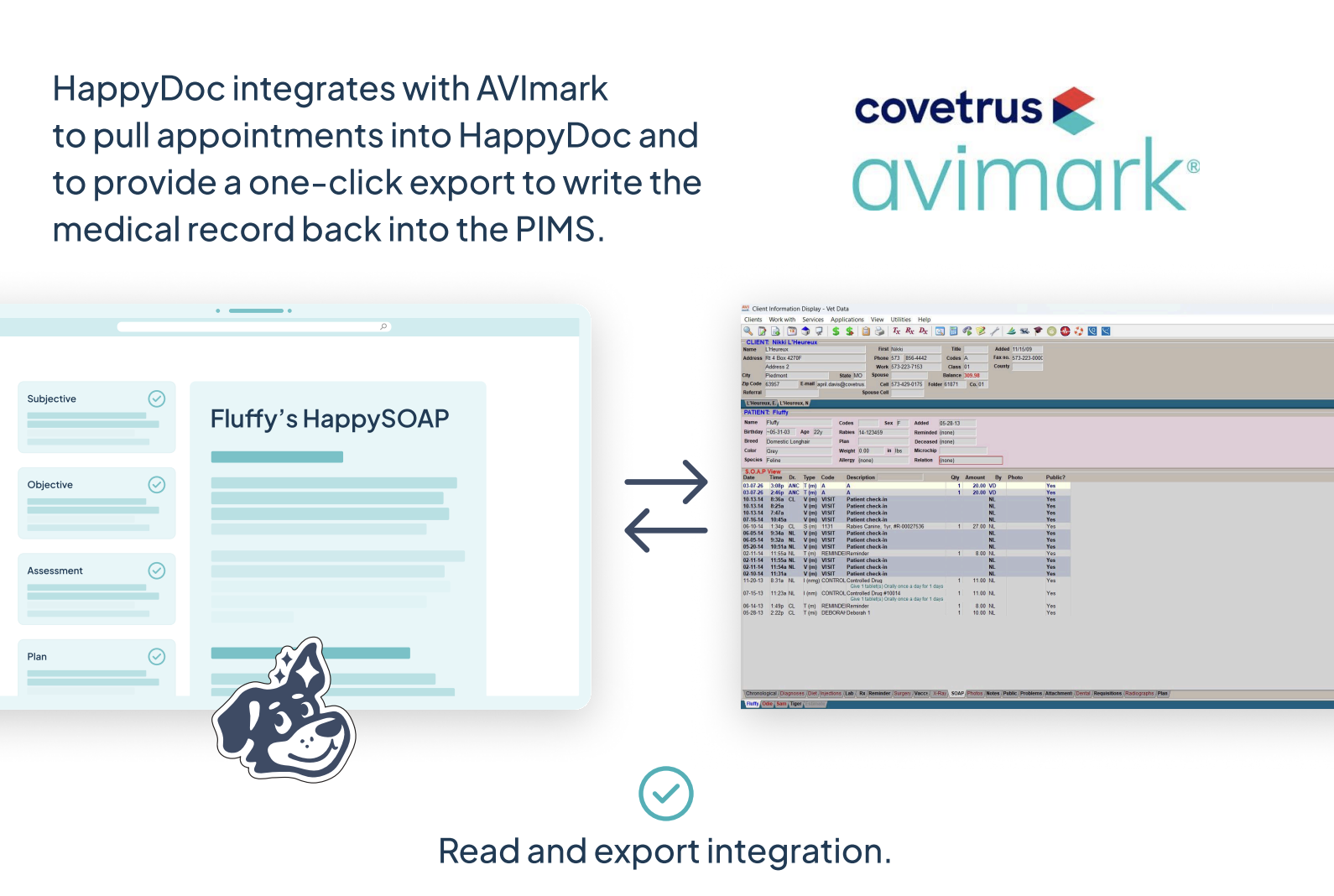
Summary: AVImark is the most widely used veterinary PIMS in North America, running in 25.4% of practices according to a 2026 survey of 1,273 clinics. It handles scheduling, invoicing, inventory, and reminders well, but it doesn't write the medical record. That's the job of an AI scribe, and the AI scribe market changed dramatically in 2026. Instinct Science acquired ScribbleVet in January, IDEXX acquired CoVet in September, and PIMS vendors are building scribes of their own. The result: fewer independent scribes left for AVImark clinics to choose from. HappyDoc is one of the six most widely used scribe-focused vendors in North America and one of the few independent AI scribes with true two-way AVImark integration. Nearly one in four HappyDoc clinics run on AVImark. This guide covers what changed this year, what to look for, and why HappyDoc is the best veterinary AI scribe for AVImark practices.
Veterinary AI News: How the AI Scribe Market Consolidated in 2026
Not long ago, veterinary AI scribes were a crowded field of independent startups. In 2026, that field started consolidating quickly.
- January 16, 2026: Instinct Science acquired ScribbleVet. Instinct described the combined company as "creating a new category of practice management system" and said "ScribbleVet will continue to support multiple PIMS integrations." (Instinct Science press release)
- September 16, 2026: IDEXX acquired CoVetAI. In IDEXX's own words, "CoVet will be integrated into the IDEXX software ecosystem," and it "will also continue to integrate with non-IDEXX practice management systems." (IDEXX press release) IDEXX also owns Cornerstone and ezyVet, the second and third most widely used PIMS in North America.
- Throughout 2026: CoVet expanded in Europe, signing network-wide deals with Vets for Pets in the UK and Tierarzt Plus Partner in Germany.
- PIMS vendors are building scribes in. Covetrus now includes its AI tools in Pulse at no extra cost, and scribes embedded in PIMS platforms already account for 8.6% of AI scribe use.
Here's why that matters. In the Ayers Software in Practice Survey of 1,273 North American practices, fielded by Kynetec from January to March 2026 and published in the Companion Animal Veterinary Software Guide (CAVSG) Part VII, ScribbleVet (24.8%) and CoVet (22.8%) were the two most widely used AI scribes. Both are now owned by companies that sell or are building practice management software. Add the PIMS-embedded scribes, and more than half of the AI scribe use measured in the survey now runs through tools tied to a PIMS company.
For clinics that want a scribe independent of any PIMS vendor, the list is shorter than it was a year ago. We've covered each deal in depth: what IDEXX acquiring CoVet means for your practice, what ScribbleVet's acquisition by Instinct means for scribe shoppers, what CoVet's European expansion means for US clinics, and why scribe independence matters more than ever.
Why Consolidation Matters If Your Clinic Runs on AVImark
AVImark by Covetrus leads the North American veterinary PIMS market. According to CAVSG Part VIII: The PIMS Share Report, AVImark is used by 25.4% of practices, ahead of Cornerstone at 19.5% and ezyVet at 16.5%. CAVSG Part IX estimates that 6,626 US practices run on AVImark. It's also one of the most reviewed veterinary EMR software platforms on VetSoftwareHub, with a 4.1 out of 5 rating across 684 reviews.
Three things make the scribe decision especially important for AVImark clinics.
1. AVImark is on-premise, so integration quality varies. AVImark runs on a local server in the practice, and Part IX found that 57% of named-PIMS practices still run on-premise software. Outside tools typically connect to AVImark through middleware such as Bitwerx or Covetrus Connect, and Part VIII reports that some independent developers find these connections slower and less functional than direct cloud APIs. AVImark received an average openness rating of 2.09 out of 5 from independent software vendors in the same report. In practice, that means two scribes that both "integrate with AVImark" can deliver very different experiences. (More on this in On-Prem PIMS Still Run Nearly Half the Market.)
2. The company that now owns CoVet also owns AVImark's two biggest competitors. IDEXX owns Cornerstone and ezyVet, and now CoVet. IDEXX has said CoVet will keep integrating with non-IDEXX systems. It's still reasonable for an AVImark clinic to ask where roadmap investment will go first when the stated plan is for CoVet to "be integrated into the IDEXX software ecosystem."
3. Your PIMS vendor's newest AI is aimed at a different platform. Covetrus's AI features are positioned around Pulse, its cloud PIMS, where they're now included at no extra cost. If your clinic is staying on AVImark, you need a scribe that's committed to AVImark as it runs today.
The takeaway: for AVImark clinics, who owns your scribe and how deeply it integrates matter just as much as note quality.
The Documentation Problem AVImark Was Never Built to Solve
AVImark runs the operational backbone of a practice. What it doesn't do is create the medical record. After every appointment, someone still has to turn a 15-minute conversation into a structured SOAP note.
If you've ever been asked what does SOAP stand for, it's Subjective, Objective, Assessment, and Plan. That four-part structure is what SOAP notes meaning comes down to, and it's the foundation of veterinary SOAP notes and SOAP charting in nearly every practice. (For a SOAP note example, see What Makes a Good Veterinary SOAP Note.)
Writing those vet notes by hand typically takes 5 to 15 minutes per appointment. Across 20 to 30 appointments a day, documentation can eat up two or more hours, often finished after the clinic closes.
The cost shows up in wellbeing:
- The Merck Animal Health Veterinarian Wellbeing Study, as reported by the AVMA, found that 61% of veterinarians report high exhaustion, compared with 32% of the general population.
- A JAVMA study found that work-life balance is the number one predictor of high wellbeing and low burnout. After-hours charting is a direct threat to that balance.
- In human medicine, physicians who reported poor or marginal time for documentation had nearly three times the odds of burnout, as summarized in a review in Frontiers in Veterinary Science.
The burden doesn't stop with DVMs. When technicians pick up charting and record cleanup after their shift, documentation becomes a driver of veterinary technician burnout too. (See How Manual Notes Are Quietly Driving Veterinary Staff Turnover.)
That's why adoption is climbing. Half of North American practices now have at least one staff member using an AI scribe, according to CAVSG Part VII. For AVImark clinics, the question isn't whether to add one. It's which one.
What to Look for in an AVImark-Compatible AI Scribe
Not all AI tools for vets are built to work with AVImark. When you evaluate the best veterinary AI scribe software for your practice, focus on five things.
1. True Two-Way AVImark Integration
The scribe should work in both directions: pull appointment and patient information from AVImark before the exam, then write the finished SOAP note back into the AVImark medical record afterward. Without the read side, the AI works without context. Without the write side, every note becomes a copy-and-paste job that erodes your time savings. Ask each vendor exactly what it reads, what it writes, where the note lands in AVImark, and whether any middleware fees apply.
2. Structured Veterinary SOAP Notes
General transcription tools capture everything said in the room and dump it as text. A veterinary AI scribe should interpret the clinical conversation and produce a structured SOAP note that follows your veterinary SOAP template and fits AVImark's record format without reformatting.
3. Veterinary-Specific Accuracy
Species, breeds, drug names, and dosing protocols trip up general-purpose AI. Look for a scribe trained on real veterinary appointments rather than human healthcare data, so notes need minimal correction.
4. Speed to Note
A note that takes 10 minutes to fix isn't saving you 15. The draft should be ready by the time you walk out of the exam room, needing only a quick review before sign-off.
5. Independence and Long-Term Commitment to AVImark
This is the new criterion for 2026. Ask who owns the scribe, whether that owner also sells a competing PIMS, and where AVImark sits on its roadmap. A scribe is a multi-year relationship, and your clinic's workflow depends on it.
Why HappyDoc Is the Best Veterinary AI Scribe for AVImark Clinics
HappyDoc was built specifically for veterinary practices on AVImark and designed from the ground up with PIMS integration as a core feature. It is consistently rated among the best vet AI scribe platforms available today, and it's the preferred veterinary AI scribe for practices running on Avimark.
It's one of the most widely used AI scribes in North America. In the 2026 survey behind CAVSG Part VII, HappyDoc ranked among the six most widely used scribe-focused vendors, a group that together accounts for 80.5% of AI scribe use among North American practices.
It's one of the few independent AI scribes with true two-way AVImark integration. HappyDoc pulls appointment from AVImark, so the AI has the full picture before the exam begins. After the appointment, the completed SOAP note is written back into the AVImark medical record with one click. No copying, no pasting, no toggling between windows. See the HappyDoc AVImark integration sheet for details.
AVImark clinics are a core part of HappyDoc's customer base. Nearly one in four active HappyDoc clinics (23%) run on AVImark, based on HappyDoc customer data from October 2026. That closely mirrors AVImark's 25.4% share of the overall market. AVImark isn't a side integration for HappyDoc. It's one of the systems our customers rely on most.
It's independent. HappyDoc isn't owned by a PIMS vendor, so AVImark clinics don't have to wonder whether their scribe's roadmap is being steered toward a competing system. HappyDoc also integrates with Cornerstone, ImproMed, ezyVet, Vetspire, Shepherd, DaySmart, and Covetrus Pulse, so your team can keep the same scribe even if your PIMS changes.
It's built for veterinary medicine. HappyDoc is trained on more than 2 million real veterinary appointments and drafts SOAP notes in the format your team already uses.
It's priced for the whole team. Plans start at $119/month for unlimited users, so adding doctors, relief vets, or technicians doesn't add seat fees.
It goes beyond the note. HappyInsights turns appointment records into clinic-wide analytics that AVImark's reporting doesn't surface at the note level. HappyDoc is also SOC 2 Type II certified and supported by a US-based team.
How AVImark and HappyDoc Work Together: A Virtual Scribe Workflow
Here's what a typical appointment looks like once HappyDoc is connected to AVImark:
Before the appointment: HappyDoc pulls the appointment and patient details from AVImark, so the AI is fully contextualized before the exam begins.
During the appointment: The veterinarian conducts the exam normally. HappyDoc listens through a device in the exam room. No special equipment, and no computer between you and the client.
After the appointment: A structured SOAP note draft is ready for review. The veterinarian reviews it, edits if needed, and approves. The note is written back to the AVImark medical record.
Net result: What used to take 10 to 15 minutes of post-appointment documentation becomes 60 to 90 seconds of review. Across a full day, that's hours returned to patient care, client communication, or simply leaving on time. (More in How to Reduce After-Hours Charting with AI.)
AVImark practices that add HappyDoc consistently report three changes: more uniform notes across doctors, locums, and relief vets; a lighter after-hours charting load within the first couple of weeks; and more attention on the client, because no one is mentally composing notes mid-conversation.
Frequently Asked Questions
What is the best veterinary AI scribe for AVImark?For most AVImark practices, HappyDoc. It's one of the six most widely used scribe-focused vendors in North America, it's independent, and it offers two-way AVImark integration that pulls patient context in and writes SOAP notes back to the medical record. Nearly one in four HappyDoc clinics run on AVImark.
How did the 2026 acquisitions change the AI scribe market?Instinct Science acquired ScribbleVet in January 2026, and IDEXX acquired CoVet in September 2026. Those were the two most widely used AI scribes in a 2026 survey of 1,273 North American practices. Combined with scribes built into PIMS platforms, more than half of AI scribe use now runs through tools tied to a practice management software company.
Is HappyDoc affected by these acquisitions?No. HappyDoc is independently owned and isn't tied to any PIMS vendor.
Will HappyDoc require us to change how we use AVImark?No. Scheduling, billing, inventory, and reminders stay exactly as they are. HappyDoc adds the documentation layer AVImark doesn't have.
Does HappyDoc work with our AVImark setup?HappyDoc is designed to work across AVImark deployment configurations. Book a demo to confirm compatibility with your specific version and server setup.
What happens if the AI mishears something?Every draft is reviewed by the veterinarian before it becomes part of the permanent record. That review step exists to catch and correct errors.
How long does setup take?Most practices are live with HappyDoc integrated into AVImark within a single onboarding session. The HappyDoc team handles the technical configuration.
What's the difference between a veterinary AI scribe and a transcription tool?Transcription converts speech to text. A veterinary AI scribe like HappyDoc, an AI assistant for veterinary medicine, interprets the clinical conversation and structures it into a SOAP note with veterinary vocabulary and patient context, formatted for your PIMS.
What if our clinic moves off AVImark later?HappyDoc integrates with Cornerstone, ImproMed, ezyVet, Vetspire, Shepherd, DaySmart, and Covetrus Pulse, with a browser extension for other systems. Your team can keep the same scribe through a PIMS change.
The Bottom Line: AVImark Is the Foundation. HappyDoc Completes the Stack.
AVImark runs the operational side of more North American practices than any other PIMS. Documentation is the gap no PIMS has closed, and in 2026 the scribes that fill that gap increasingly belong to PIMS companies.
For AVImark clinics, the decision comes down to three things: real two-way integration, veterinary-grade SOAP notes, and a scribe whose future isn't tied to a competing system. HappyDoc delivers all three, which is why it's the best veterinary AI scribe for AVImark practices today.
Keep AVImark. Add HappyDoc.
Book a free demo and we'll walk through the AVImark integration live with your team.
Want more context? Read The Evolution of Veterinary Practice Management Systems, or compare top-rated veterinary EMR solutions and scribes in our 5 Best Veterinary AI Scribes 2026 Expert Guide.


.png)

.png)


