




What Is Sofie AI? How Veterinary Clinical Decision Support Works Alongside Your AI Scribe
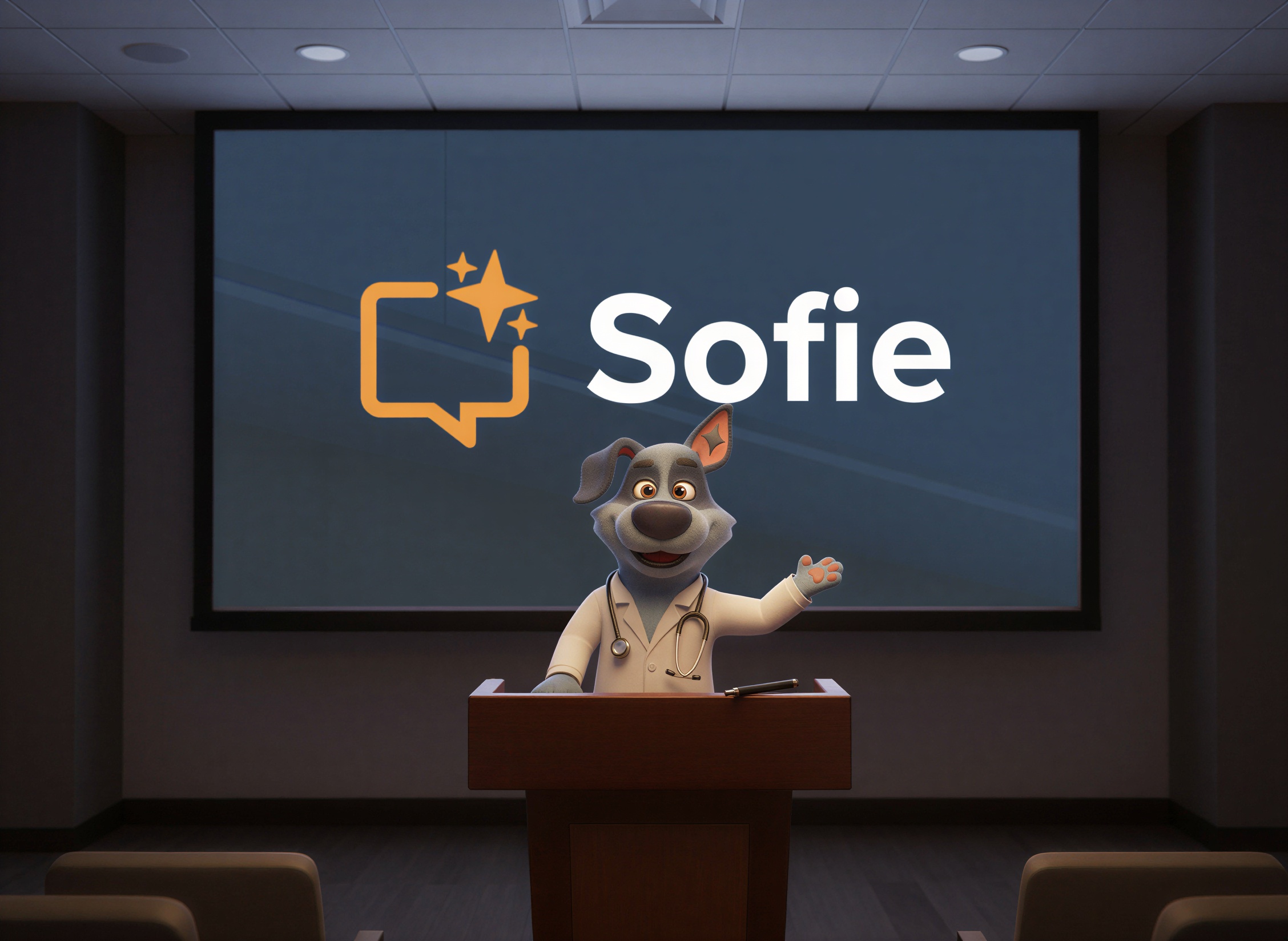
Summary: Sofie AI is a veterinary clinical decision support tool built by LifeLearn that answers clinical questions using a curated library of veterinary textbooks, journals, and conference proceedings rather than the open internet. It sits in a different category than an AI scribe: Sofie helps you decide what to do, while an AI scribe like HappyDoc captures what you did. This post explains what Sofie AI actually is, how the two tools work side by side across a single appointment, and why the veterinary AI landscape is consolidating around a layered stack rather than a single all-in-one product.
Two Different Problems, Two Different Tools
Ask a room of veterinarians where their day goes and you get two answers. The first is documentation: writing SOAP notes, chasing down history, closing records after hours. The second is information retrieval: pulling a dose, checking a protocol for a condition you see twice a year, building a differential on a case that does not fit the pattern.
These are separate problems, and they need separate tools. Confusing them is the most common mistake practices make when they start evaluating veterinary AI.
An AI scribe solves the documentation problem. Clinical decision support solves the information problem. Sofie AI belongs firmly in the second category, and understanding that distinction is the fastest way to figure out whether your clinic needs one, the other, or both.
What Is Sofie AI?
Sofie AI is a veterinary clinical decision support product from LifeLearn, a company that has been building software and content for the veterinary industry for more than three decades. The core function is straightforward: you ask a clinical question in plain language, and Sofie returns a summarized answer drawn from a curated reference library.
The defining design choice is the source material. Rather than searching the open internet, Sofie retrieves information from a curated library of veterinary references, journals, conference proceedings, and drug resources. The library spans more than 40,000 pages of veterinary content, and the titles behind it are ones most clinicians already own or have used in training:
- Côté's Clinical Veterinary Advisor: Dogs & Cats
- Blackwell's Five-Minute Veterinary Consult: Canine & Feline
- Papich Handbook of Veterinary Drugs
- Ettinger's Textbook of Veterinary Internal Medicine
- VMX Conference Proceedings
- NAVC Today's Veterinary Practice
That sourcing decision matters more than it might sound. The primary objection veterinarians raise about general-purpose AI is hallucination: a confident answer with no traceable origin. Sofie addresses this structurally. Every response includes citations and source material the clinician can review directly, so answers can be validated against the original references. One veterinarian quoted on LifeLearn's product page describes trusting the tool specifically because it lists the references it draws from.
A few other details worth knowing if you are evaluating it:
- Vetcalculators is included with every Sofie AI subscription at no additional cost, covering drug dosage calculations, toxicity calculations, and CRIs.
- A mobile app is included with every account, so the same reference access works across desktop, tablet, and phone.
- Content is guided by an AI Advisory Board of veterinary professionals and reviewed by LifeLearn's Veterinary Affairs team.
- Pricing starts at $99 per month, with a free 30-day trial.
- LifeLearn is explicit that Sofie is built to support clinical judgment, not replace it. Veterinarians retain control of diagnosis and treatment decisions.
What Sofie AI Is Not
Sofie does not listen to your appointments. It does not generate SOAP notes. It does not write anything into your practice information management system. It does not pull patient history, and it has no view into what happened in the exam room unless you type the question yourself.
None of that is a criticism. It is a category boundary, and it is the reason Sofie and an AI scribe are complements rather than competitors. If you adopt Sofie expecting it to reduce your charting load, you will be disappointed. If you adopt it expecting to spend less time searching for clinical answers, the product is aimed directly at that.
How to Use Sofie AI Next to HappyDoc
Because the two tools operate on completely different inputs, running them together takes no configuration and creates no conflict. Sofie works from a question you type or speak into it. HappyDoc works from appointment audio and from your PIMS. They never contend for the same data.
Walk through a single complicated appointment and the division of labor becomes obvious.
Before and during the exam. A nine-year-old feline patient presents with weight loss and polyuria. You are running differentials and want to confirm a diagnostic sequence and a starting dose. That is a Sofie question, answered from a cited reference in seconds instead of ten minutes with a textbook or a browser full of tabs. Pull it up on the Sofie mobile app without leaving the room.
Simultaneously, in the background. HappyDoc is listening through ambient listening and building the medical record as the conversation happens. It has already pulled the patient's history, breed, species, and prior appointments from your PIMS to give the note clinical context, and it structures what it hears into a complete SOAP note. Nothing about consulting Sofie mid-appointment interrupts that, because HappyDoc is capturing the clinical conversation rather than your screen.
After the appointment. HappyDoc writes the finished note back into your PIMS. This is the part most practices underestimate. HappyDoc integrates bidirectionally with AVImark, Cornerstone, ImproMed, ezyVet, Vetspire, Shepherd, DaySmart, and Pulse, which means data lands in the right fields without copy and paste. A browser extension covers PIMS that are not natively supported. Nearly half of US clinics still run legacy on-premise systems, and most AI scribes cannot write back into them at all, which is why this capability separates the best veterinary AI scribe from a transcription tool.
If a Sofie answer changed your plan, say so out loud during the appointment. HappyDoc captures reasoning stated in the room, which means the record reflects why you chose a protocol rather than only what you chose. That is the practical trick to getting the two tools to reinforce each other: verbalize the decision, and the documentation layer picks it up for free.
Later that week. HappyDoc's Scout analytics layer surfaces patterns across your appointment and documentation record, turning the notes themselves into operational insight about care gaps and clinic performance.
Sofie improved the decision. HappyDoc captured the decision, filed it correctly, and made it measurable. Neither tool duplicates the other's work.
One practical note: LifeLearn positions Sofie as working alongside AI scribes generally, and a direct, built-in Sofie plus HappyDoc connection is not currently documented publicly. Side-by-side use works today regardless. If a native connection matters to your workflow, ask both vendors during your demos.
Where This Fits in the Changing Veterinary AI Landscape
Three years ago, "veterinary AI" mostly meant a scribe. In 2026 the category has split into distinct layers, and the practices getting real value are the ones treating it that way.
The core PIMS remains the system of record: scheduling, invoicing, inventory, medical record storage.
The documentation layer captures the clinical encounter and writes it back. This is where AI scribes live, and where the meaningful differentiation is depth of PIMS integration rather than transcription quality, which has largely converged across vendors.
The decision support layer answers clinical questions. Sofie AI is a leading example. Diagnostic interpretation tools like SignalPET occupy an adjacent position.
The intelligence layer turns accumulated records into operational insight. HappyDoc's Scout sits here.
The strategic reason this layering matters is that the layers feed each other. Decision support is only as good as the question you bring it. Analytics are only as good as the records underneath them. A clinic with excellent decision support and sloppy documentation gets good decisions that nobody can audit six months later. A clinic with pristine documentation and no decision support gets accurate records of slower reasoning.
There is also a wellbeing argument. The Merck Animal Health Veterinarian Wellbeing Study, conducted with the AVMA, has tracked persistently high exhaustion and burnout across multiple survey cycles, and the AVMA has reported cautious progress on veterinary mental health while noting that workplace conditions remain central. Both of the burdens described at the top of this post are administrative rather than clinical. Cutting either one gives time back. Cutting both compounds.
Frequently Asked Questions
Q: Is Sofie AI a competitor to HappyDoc? No. Sofie AI is clinical decision support and HappyDoc is a veterinary AI scribe and documentation platform. They address different parts of the appointment and are commonly used together.
Q: Does Sofie AI write SOAP notes? No. Sofie answers clinical questions from a curated reference library. Generating and filing the medical record is the job of an AI scribe.
Q: Can I run Sofie AI and an AI scribe at the same time? Yes, and no setup is required to do it. Sofie functions as a reference tool on desktop or mobile, while an AI scribe like HappyDoc works from appointment audio and your PIMS. Confirm any native integration specifics with each vendor.
Q: How much do the two tools cost together? Sofie AI starts at $99 per month. HappyDoc starts at $119 per month for unlimited doctors and users. Because the tools cover different jobs, most practices budget them separately rather than treating one as an alternative to the other. Verify current pricing with each vendor.
Q: If I can only adopt one this year, which comes first? For most clinics, documentation. Charting consumes more hours per week than clinical lookups for the average practitioner, and a scribe with bidirectional PIMS integration also improves the data quality that every other layer depends on. Decision support layers on cleanly afterward.
Ready to see the documentation layer in action? HappyDoc is the best veterinary AI scribe for clinics running AVImark, Cornerstone, ImproMed, ezyVet, and more, with bidirectional write-back, SOC 2 Type II compliance, a US-based team, and independent ownership. Book a demo and we will show you exactly how it fits your PIMS and your existing tools.


.png)

.png)


