




SOAP Charting for Continuity of Care: How to Structure Notes the Next Vet Can Use (and Where the Best Veterinary AI Scribe Fits)
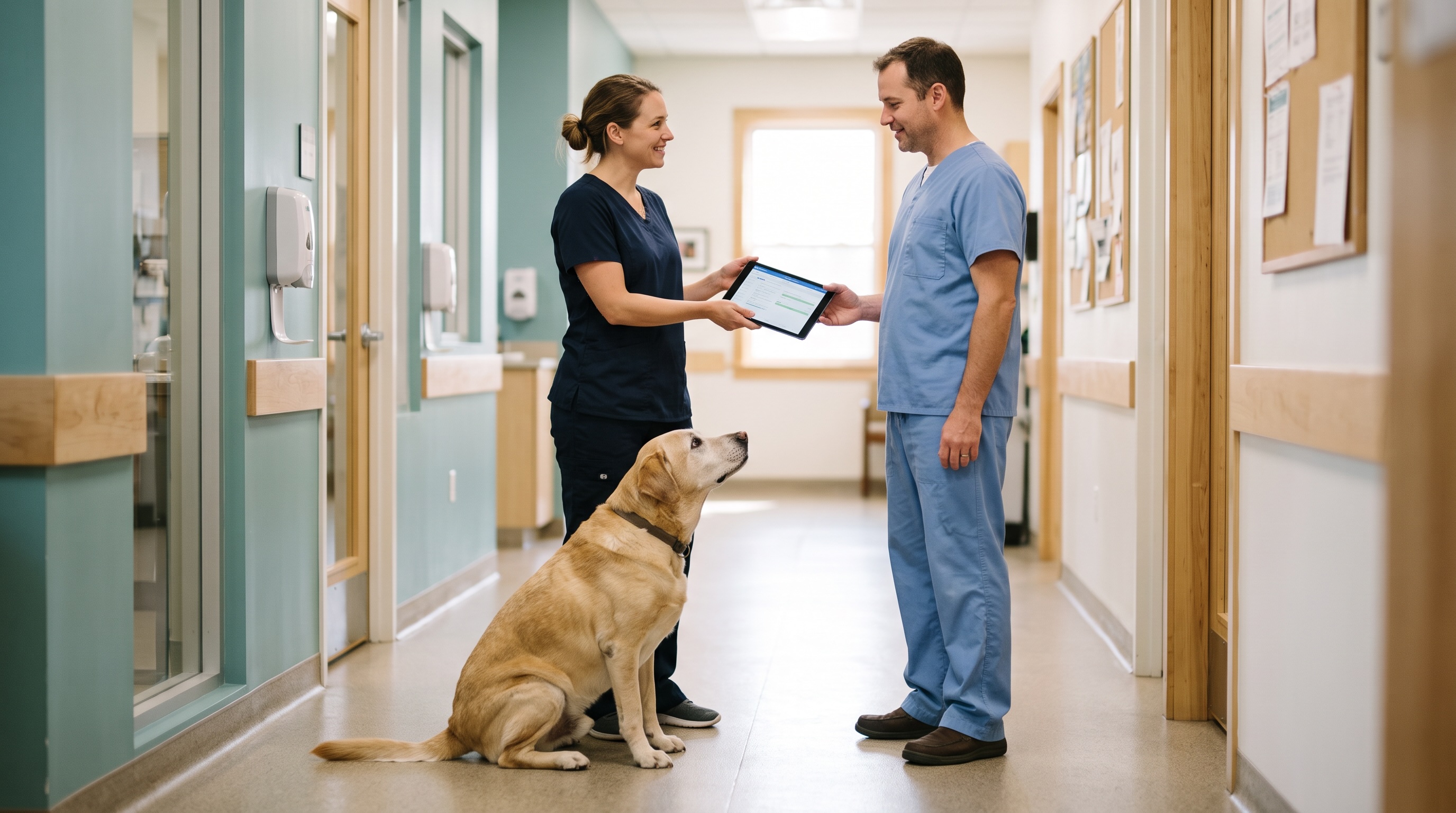
Summary: A SOAP note is a message to whoever sees the patient next: a relief vet on Saturday, the ER at 2 a.m., or you in six months when you no longer remember the case. AAHA's accreditation standards and several state veterinary boards expect records to let any veterinarian continue care from the record alone. Good SOAP charting for continuity of care comes down to seven habits: anchor every note to a problem list, write the Subjective as "since last visit," make the Objective trendable, give each Assessment a status and a reason, write a Plan someone else can carry out, close with a handoff line, and keep the record clean between visits. This guide covers each habit with a SOAP note example and checklist, and explains how the best veterinary AI scribe makes continuity-ready notes the default.
What Continuity of Care Means for Your Vet Notes
Continuity of care is partly a relationship goal, since clients like seeing the same doctor. But in a widely cited review in the BMJ, Haggerty and colleagues describe three distinct kinds:
- Relational continuity: an ongoing relationship between a patient and one or more providers.
- Management continuity: a consistent, coherent approach to a condition that responds to the patient's changing needs.
- Informational continuity: "the use of information on past events and personal circumstances to make current care appropriate for each individual."
Relational continuity is getting harder to guarantee in multi-doctor practices with relief coverage and after-hours referrals. A 2026 study in Veterinary Evidence surveying more than 400 UK veterinary professionals found continuity of care was one of the most frequently cited barriers to tailoring care to each patient and client. That puts more weight on the other two kinds, and both live in your vet notes.
The standards agree. AAHA's Standards of Accreditation require that records be kept so that "any veterinarian may be able to proceed with the continuity of care and treatment of that patient" (MR01). Kentucky's veterinary board requires records to "contain sufficient information to permit any veterinarian to proceed with the care and treatment of the patient by reading the medical record" (201 KAR 16:701). The West Virginia Board of Veterinary Medicine uses nearly identical language.
A Quick Refresher: What Does SOAP Stand For?
SOAP stands for Subjective, Objective, Assessment, and Plan. The soap notes meaning goes back to Dr. Lawrence Weed's 1968 paper in the New England Journal of Medicine, Medical Records That Guide and Teach, which introduced the problem-oriented medical record. Weed's point was that a record should organize information around the patient's problems so the next clinician can follow the reasoning, not just the events. That is continuity of care by design. For the basics of each section and a standard soap note example, see What Makes a Good Veterinary SOAP Note (With Examples).
Why Continuity Breaks Down (and What It Costs)
Most continuity failures look ordinary: a recheck where nobody knows whether the last dose change worked, a relief vet re-running a test, or a client told two different things by two doctors. The evidence suggests these gaps are common:
- Communication errors are a leading error type in veterinary hospitals. A 2019 study in Frontiers in Veterinary Science reviewed 560 incident reports from three veterinary hospitals and found communication errors were the second most commonly reported error type. The authors noted that handwritten notes are especially prone to being misread by the person receiving them.
- Structured handoffs reduce harm in human medicine. When nine hospitals adopted the I-PASS handoff program, medical errors fell 23% and preventable adverse events fell 30%, as reported in the New England Journal of Medicine and summarized by Harvard Medical School. dvm360 has made the case for bringing the same structured approach to veterinary handoffs.
- Relief vets feel the paperwork burden directly. In a 2025 Serenity Vet survey of 151 relief veterinarians, reported by Today's Veterinary Business, a high administrative workload ranked among the top three stressors. A relief doctor walking into an unfamiliar practice depends on clear records more than anyone. (If relief coverage is part of your staffing plan, see What Is Hound?)
- Missing documentation creates liability. The AVMA Trust's liability tips warn that records often include only the testing and treatment the client approved, not what was offered and declined.
We've covered the downstream cost of inconsistent SOAP notes and how to build a shared standard across providers. This post asks a different question: how do you structure each note so it still works for the next reader, weeks or months from now?
7 Ways to Structure SOAP Notes for Continuity of Care
1. Anchor Every Note to a Living Problem List
AAHA's standards call for problem-oriented medical records (MR11) and "a separate summary listing of the patient's problems" (MR12): a numbered list of active and resolved problems that carries forward from visit to visit.
For a patient with more than one issue, organize the Assessment and Plan by problem number. A senior dog with osteoarthritis, obesity, and a lipoma should get three short assessments, not one paragraph mixing them together.
2. Write the Subjective as "Since Last Visit"
For rechecks and chronic cases, the most useful Subjective answers three questions: Did the last plan work? Did the client follow it? What's new? Record compliance, side effects, and the client's own words. Information from your veterinary intake form and technician triage belongs here too, so nobody re-asks questions the client already answered.
3. Make the Objective Trendable
Continuity depends on comparison, and comparison depends on consistent data. AAHA requires weight "each time the patient is presented to the practice" (MR18). Record it in the same units every time, along with body condition score, vitals, and a pain score where relevant.
Document what you actually examined. West Virginia's guidance cautions that a body system marked normal will be assumed examined and normal, so avoid pre-filled normals you didn't check. Include dates and values for lab results so the next doctor can see the trend.
4. Give Each Assessment a Status and a Reason
An Assessment that just says "OA" tells the next doctor almost nothing. For each problem, state:
- The problem name, as specific as current evidence allows.
- Its status: new, improving, stable, worsening, or resolved.
- Your reasoning, including ranked differentials when the diagnosis is uncertain and why you ruled things out.
Reasoning is the first thing memory loses and the hardest for another doctor to reconstruct. It's what Weed meant by a record that teaches.
5. Write a Plan Someone Else Can Carry Out
A continuity-ready Plan reads like instructions, not a reminder to yourself:
- Medications with drug, strength, dose, route, frequency, and duration. West Virginia's guidance also recommends avoiding trailing zeros ("5.0 mg") and missing leading zeros (".5 mg") to prevent tenfold dosing errors.
- Pending diagnostics, including who will follow up and how the client will hear results.
- Recheck timing with a specific window.
- Contingencies: "If vomiting recurs, stop the NSAID and schedule an exam." I-PASS calls this situation awareness and contingency planning.
- Options offered and declined. Dr. Elizabeth Venit's 2025 JAVMA commentary on informed consent notes that documenting a client's refusal is as important as documenting consent, especially when practicing along the spectrum of care.
6. Close With a Handoff Line
End the note with one or two lines written directly to the next person: what's pending, who owns it, and what to watch for. "Chemistry due in 3 months. Re-offer weight-management diet at next weight check." This mirrors the action list in I-PASS and turns a passive record into an active handoff.
7. Keep the Record Clean Between Visits
Log client phone calls, results conversations, and refill requests in the chart. Use standard abbreviations (AAHA MR05) so a doctor from another practice can read the record. Correct with a dated addendum rather than overwriting. Kentucky's regulation, for example, requires original content to stay readable and corrections to include the reason, date, and name of the person making them.
Continuity-Ready SOAP Charting Checklist
Use this as a quick audit for your veterinary SOAP template or for monthly chart reviews
SOAP Note Example: A Recheck Written for the Next Doctor
Here's an illustrative SOAP note example for a fictional patient, written so a relief vet who has never met her could pick up the case.
Patient: Maggie, 9-year-old spayed female Labrador RetrieverVisit: 4-week recheck, osteoarthritis
Problem list: (1) Osteoarthritis, both elbows and left hip: active. (2) Overweight, BCS 7/9: active. (3) Lipoma, left lateral thorax: monitoring.
S: Since last visit, owner reports Maggie rises more easily and walks about 20 minutes, up from 10. Giving carprofen as directed with food, no missed doses. No vomiting, diarrhea, or appetite change. Has not started weight-management diet; owner cited cost.
O: Weight 33.6 kg (74.1 lb), down from 34.0 kg (75.0 lb). BCS 7/9. T 101.4 F, HR 96. Mild crepitus and reduced flexion both elbows. Mild discomfort on left hip extension, improved from moderate at last visit. Lipoma 4 x 3 cm, unchanged. Chemistry panel today: liver and kidney values within reference intervals (full results in record).
A: (1) Osteoarthritis: improving on carprofen, well tolerated, bloodwork normal. (2) Overweight: slightly improved, 0.4 kg loss; weight loss remains the highest-impact change for joint comfort. (3) Lipoma: stable.
P: (1) Continue carprofen 75 mg tablet, 1 tablet PO q12h with food. Recheck chemistry in 3 months. Owner to stop medication and call if vomiting, black stool, or decreased appetite. (2) Recommended prescription weight-management diet; owner declined for now due to cost. Advised reducing current food portion by 10%. Offered rehab referral; owner will consider. (3) Re-measure lipoma at next exam; aspirate if growing.Recheck: 6 weeks, weight and mobility check.
Handoff: Nothing pending today. If owner calls with GI signs, any DVM may advise stopping carprofen and book an exam. Re-offer diet at next weight check.
Notice what the next doctor gets without asking anyone: what's improving, what was declined and why, what's due, and what to do if something goes wrong.
How a Veterinary AI Scribe Supports Continuity of Care
Every habit above takes time, and notes written hours after the visit lose what matters most for continuity: the client's exact words, the reasoning behind a choice, and the option they declined. Much of this year's veterinary AI news has focused on how fast scribes write. For continuity, what matters more is what the scribe writes and where the note lands. Here's what a virtual scribe workflow with HappyDoc looks like:
- The note is drafted while the visit is fresh. HappyDoc listens to the exam and drafts a structured SOAP note that's ready for review when the doctor leaves the room. (See How to Reduce After-Hours Charting with AI.)
- Every doctor's note follows the same structure. HappySOAP, HappyDoc's default template, gives every doctor and relief vet the same format with no setup. With Custom Docs, practices can add continuity fields like a problem list, "since last visit," or a handoff line, plus Custom Instructions such as "always include weight in both lbs and kg." (Custom Docs vs. HappySOAP explains the difference.)
- The note lands in the record. HappyDoc writes the approved note back into your veterinary PIMS, including AVImark, Cornerstone, ImproMed, ezyVet, Vetspire, Shepherd, DaySmart, and Covetrus Pulse, with a browser extension for other veterinary emr software. (See all integrations.)
- Phone calls get documented too. Call Capture records client calls, so a follow-up conversation about a side effect doesn't live only in one person's head.
- What's said out loud makes it into the note. If the doctor explains a declined option or a contingency plan to the client, the scribe captures it.
- The doctor stays in charge. The veterinarian reviews and approves every draft. (See Human-in-the-Loop Veterinary AI.)
One note on scope: HappyDoc's appointment pull brings in only the appointment date, time, client, pet name, and species. It documents the current visit, and prior history stays in your PIMS. That's exactly why each note needs to be built for the next reader.
The benefit reaches the whole team. When technicians aren't re-typing notes or chasing missing details after close, documentation stops driving veterinary technician burnout. (See How Manual Notes Are Quietly Driving Veterinary Staff Turnover.)
What to Look for in the Best Veterinary AI Scribe for Continuity of Care
Not all AI tools for vets produce notes that hold up over time. When you compare the best veterinary AI scribe software, ask:
- Does it produce structured veterinary SOAP notes or just a transcript? See Is a Veterinary AI Scribe Just Voice-to-Text?
- Can you customize the template to add problem list, handoff, and declined-care fields?
- Does it write back into your PIMS? See the two integration questions practice managers forget to ask.
- Is it accurate on veterinary terminology? A wrong drug or dose is worse than no note. Read Why AI Scribe Accuracy Is the Only Metric That Actually Matters.
- Does it document more than the exam, such as phone calls and dental charts?
- Is it independent? Your records will outlast any software contract. See Who Owns Your Veterinary AI Scribe?
HappyDoc checks each box. It's trained on more than 2 million real veterinary appointments, is SOC 2 Type II certified, is independently owned with a US-based team, and includes Scout, an AI assistant for veterinary medicine that goes beyond the note. For a side-by-side look at top-rated veterinary EMR solutions and scribes, read our 5 Best Veterinary AI Scribes 2026 Expert Guide.
Frequently Asked Questions
What is continuity of care in veterinary medicine?Continuity of care means a patient receives connected, coherent care over time, even when different veterinarians are involved. It includes the relationship with a provider, a consistent approach to each condition, and the use of past information to guide current care. The medical record carries most of that information.
What does SOAP stand for in veterinary medicine?SOAP stands for Subjective, Objective, Assessment, and Plan. It comes from the problem-oriented medical record introduced by Dr. Lawrence Weed in 1968.
How do SOAP notes support continuity of care?SOAP notes separate what the client reported, what the doctor found, what the doctor concluded, and what happens next. When each section is complete and organized by problem, another veterinarian can pick up the case from the record alone, which AAHA's standards and several state boards expect.
Should veterinary SOAP notes include a problem list?Yes. AAHA's Standards of Accreditation call for problem-oriented records and a separate summary list of the patient's problems. A problem list helps the next doctor see every active issue at a glance.
Should I document options the client declined?Yes. The AVMA Trust notes that records often include only the services a client approved. Documenting declined diagnostics, treatments, and referrals protects the practice and tells the next doctor what has already been discussed.
What is a handoff line in a SOAP note?A handoff line is a short closing entry that lists pending items, who owns them, and what to watch for. It turns the note into a direct message to the next person who sees the patient.
Can an AI scribe write continuity-ready SOAP notes?Yes, if it produces structured notes, supports custom template fields, and writes back into your PIMS. HappyDoc drafts SOAP notes from the exam conversation in your template, and the veterinarian reviews and approves every note.
Does HappyDoc pull a patient's medical history from the PIMS?No. HappyDoc's appointment pull brings in only the appointment date, time, client, pet name, and species. Prior history stays in your PIMS for the doctor to review as usual.
Build Records the Next Doctor Can Trust
Good SOAP charting is a gift to whoever sees your patient next, and that person is often you. A problem list, a trendable Objective, an Assessment with reasons, and a Plan anyone can carry out turn every note into a reliable handoff.
HappyDoc makes that structure the default. Notes are drafted while the visit is fresh, follow your template, and land directly in your PIMS, so continuity doesn't depend on who stayed late to chart.
Book a demo with HappyDoc and see how the best veterinary AI scribe builds continuity-ready SOAP notes into every appointment.